Once upon a time, in a land far far away, there lived many innocent and adorable little animals. They lived harmoniously, always playing blissfully with no worries in hand. The days were sunny, birds sang melodiously while the breeze spread the divine music to their ears...
*OK, what da hell?!*
Happy Tree Friends is a Flash cartoon series by Mondo Mini Shows, created by Rhode Montijo, Kenn Navarro and Aubrey Ankrum. This is not your ordinary cartoon stories, depicting a valuable moral behind every episode. As indicate in the official site, the show is "not recommended for small children".
WHAT?!! Cartoon not for children? Hentai? XXX Animal Cartoon?
~Eyes covered to ensure character's identification not exposed~
Ok, before you jump to those conclusions, no, Happy Tree Friends DO NOT promote sexuality, instead, they promote extreme *not enough impact* ...EXTREME violence, with every episode featuring blood, gore and violent deaths.
If you think the pictures in the toilet post is graphic, this is worse! but in animated approach :)
Here are some regular characters from Happy Tree Friends:
Cloned Turkish Angora cats (left) that glows (right) under ultraviolet beams.
~Images by AFP~
South Korean scientists have cloned cats that glow red when exposed to ultraviolet beams in a side-effect, by manipulating a fluorescent protein gene - a procedure which could help develop treatments for human genetic diseases.
A team of scientists led by Kong Il-keun, a cloning expert at Gyeongsang National University, produced three cats possessing altered fluorescence protein genes (RFP). Three cats were born in January and February - one died while two others grew to become adult Turkish Angoras, weighing 3.0kg and 3.5kg.
It marked the first time in the world that cats with RFP genes have been cloned. The ability to produce cloned cats with the manipulated genes is significant as it could be used for developing treatments for genetic diseases and for reproduction model (cloned) animals suffering from the same diseases as humans.
It will also help develop stem-cell treatments; cats have some 250 kinds of genetic diseases that affect humans, too.
"Cats have similar genes to those of humans," said veterinary professor Kong Il-keun. "We can make genetically modified cats that can be used to develop new cures for genetic diseases."
Keitaro Kato, a geneticist at Kinki University in western Japan who has cloned fish, said the research could be significant if it eventually helps treat people with hereditary diseases.
"People with genetic disorders usually have to receive treatment throughout their lives that is very hard on them," Kato said. "If these results can help to make their lives easier, then I think it's a wonderful thing."
Carl Hulsey, a 77-year-old retired poultry worker from Canton, Georgia was determined to turn his white billy goat, Snowball, into a watchdog, whether Snowball wanted to be one or not. To that end, Hulsey took to beating Snowball with a stick to make it more aggressive. "Pa, this goat's going to kill you if you keep that up," Alma Hulsey warned her husband. Little did she know, she turned out to be right.
On 16 May 1991, Hulsey once again approached the goat, brandishing a stick. This time Snowball landed the first blow. The 110-pound goat attacked its tormentor, headbutting Hulsey in the stomach, twice knocking him down. Hulsey scrambled onto the porch in an effort to get away. The goat bounded up the steps after him. While Alma Hulsey watched, Snowball rammed its master over the edge. Hulsey fell to the ground five feet below, and died where he landed. "Blunt trauma to the abdominal cavity," said the coroner. Snowball had ruptured Hulsey's stomach.
As a dangerous animal who might harm another, by rights, Snowball should have been put to sleep. Once the goat's story was known, however, the officials who were to decide Snowball's fate were inundated with pleas to spare the creature. More than 500 protesters from around the nation called Cherokee County animal control after it was announced Snowball might be put to death. Many offered to adopt Snowball.
Some even made death threats. "What happens to the goat, happens to you," one caller reportedly warned. There was also talk of a bomb being planted if the goat did not walk. (aren't they taking this a little too seriously, all for a goat?)
Snowball got let off. It was sent to Noah's Ark, a private animal shelter for neglected, and abused animals in Locust Grove, a little town south of Atlanta. Four hours after its arrival, it was laid on a kitchen table and neutered, an operation intended to make it less aggressive. It was also rechristened "Snow."
Why this furor over a goat and the seeming lack of concern for the man whose life the goat had ended? In the small community Hulsey had been part of, he was well and truly mourned. Yet outside that pocket of acquaintance, sentiment ran the other way - many animal lovers saw a certain divine justice in his fate. He'd brought harm to an animal, and the animal had struck back.
Whoever thought that such a goliath mammal would be afraid of tinylittle bees? Researchers have discovered that these giants FLEE at the buzz of a swarm of bees.
This statement is backed up by observers in Kenya who notice that elephants damaged acacia trees with empty or occupied beehives significantly less than trees without hives. Moreover, in Zimbabwe, elephants forged new trails in order to avoid beehives.
Well, to note why the elephants are afraid, honeybees native to eastern and southern Africa (Apis mellifera scutellata) are notoriously aggressive, especially near their hives. It has been known that swarms are able to kill an African buffalo.
To confirm whether bees could really drive away elephant herds, zoologist Lucy King at the University of Oxford and her colleagues carried out an experiment (as seen on video below).
Firstly, the team had to digitally record the buzz of agitated African bees from a wild hive, found inside a tree trunk along the Ewaso Ng’iro River in Samburu. Their initial attempt was to hold a microphone in front of the hive and drop a stone into the core of the tree trunk.
So, it was that easy?
WRONG!!
The bees were so aggressive that even with their bee suits on, they got swarmed with bees and could not hold the microphone very straight for very long!
In their second attempt, King rigged up a platform in front of the hive where they strapped on the directional microphone and mini-disc recorder so that they could evacuate the area while recording.
“I dropped a stone into the hive to trigger the attack, and then we ran like hell back to my Land Rover and sealed ourselves inside for a good 15 minutes while the bees did our recording for us. It was actually a fun day despite one or two stings getting through our suits!” King said.
Place wireless speakers hidden inside fake plastic tree trunks under trees in Kenya (where the elephant families happily having their midday picnic under the blazing hot sun)
Played back four-minute clips of the recorded buzzing of bees.
Results:
Complete SUCCESS!!
16 out of 17 families tested fled within 80 seconds of hearing the bee sound, and half responded within just 10 seconds.
The one family that did not respond to the buzzing was young and perhaps had not experienced bee attacks before. (OR they ate up the ‘sappy’ plastic tree trunks~)
With these new findings, the researchers hope to use beehives to deter elephant herds from human farmland and enhance local income through sale of honey, as well as contribute to a safer future for both elephants and the people who have to live with them.
(Spider-cat, Spider-cat, does whatever a Spider-cat can...)
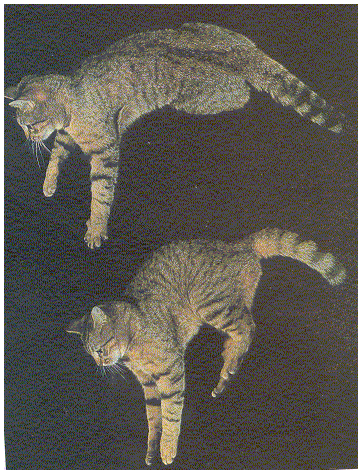
You may think that falling cats always land on their feet. Contrary to that popular belief, every day cats DO sustain serious injuries from falling out of open windows, off balconies, and from rooftops.
Unlike me (or most human), cats are not acrophobic (fear of heights), and will often leap after a bird or butterfly only to find themselves falling through the air. The trauma sustained from a fall of over two stories (24 to 30 feet) is known as high-rise syndrome.
Usually, if a cat falls a short distance, it can right itself and land on its feet, due to its exceptional coordination and balance, and flexible musculoskeletal system. However, if it falls more than one or two floors, it may sustain injury because its legs and feet cannot absorb the shock.
Textbook Guidelines for Cats to Survive a Fall:
The cat determines which way is up and rotates the head until it is right side up.
It brings the front legs up close to the face, ready to protect it from impact.
It twists the upper part of the spine to bring the front half of its body around in line with the head.
It bends its hind legs so that all four limbs are ready for touchdown and, as this happens, it twists the rear half of its body to catch up with the front.
However, whether or not a cat lands on its feet depends on several factors, including the distance it falls and the surface on which it falls.
Righting Reflex
Cats have the ability to right themselves in midair thanks to the vestibular apparatus. This is a tiny fluid-filled organ housed deep in their inner ear that is responsible for their remarkable balance. It is composed of tiny chambers and canals lined with millions of sensitive hairs and filled with fluid and minute floating crystals. When cats move, the fluid shifts, giving readings on the body's position – similar to the instrument in an airplane called the "artificial horizon" that tells the pilot the position of the plane's wings in relation to the horizon.
When a cat falls, the vestibular apparatus becomes active, and helps the cat register which way is up. This allows the cat to right himself in midair by adjusting the orientation of the body. The righting reflex appears in a kitten at three to four weeks and is perfected by seven weeks.
Musculoskeletal System
The uniqueness of the cat's skeleton is another reason they can right themselves. A cat does not have a collarbone and the bones in his backbone have more mobility than in many other animals. So cats have free movement of their front legs and they can bend and rotate their bodies like a pretzel.


 ~Eyes covered to ensure character's identification not exposed~